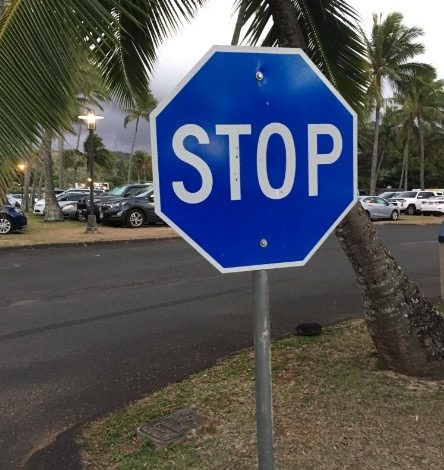
Since they aren’t allowed on public roads, blue stop signs appear mainly on private property:
- Gated communities or private neighborhoods: Slow traffic and mark intersections
- Shopping centers or parking lots: Manage vehicle and pedestrian flow
- College or corporate campuses: Some match school or company colors (e.g., “Yale blue”)
- Industrial parks or warehouses: Control traffic in loading zones or employee areas
In these areas, blue signs are less about law and more about safety, courtesy, and internal rules.
Do You Have to Stop?
- Respect: Ignoring the sign can upset residents or security
- Safety: Prevent crashes where pedestrians are present
- Rules: Private communities may fine violators
- Insurance: Accidents from ignoring a blue stop sign could complicate claims
Golden Rule: If a sign says “STOP,” stop—regardless of color. Safety always comes first.
Other Unusual Stop Sign Colors
Blue isn’t the only non-standard option:
- Green: Occasionally used in private parks or eco-themed developments
- Black-and-white: Sometimes used in historic districts for aesthetics
- Glow-in-the-dark or reflective blue: Improves nighttime visibility in private areas
None of these colors are MUTCD-compliant for public roads, but they all share the same goal: slow down and yield the right of way.
Takeaway: Red, blue, green, or black-and-white—when it says “STOP,” hit the brakes. Safety > semantics.
