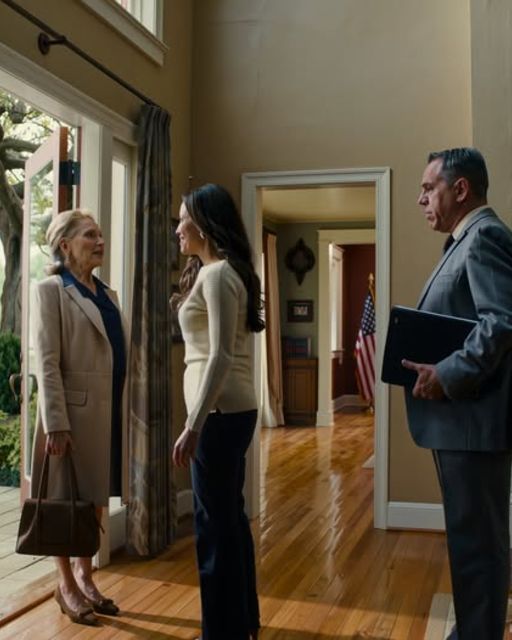
My Daughter-in-law Secretly Listed My House For Sale – Updated Stories
Kelsey scoffed, crossing her arms. “Oh, please. Don’t play psychologist. You have no idea what I’ve been through.”
The word hung in the air, cold and sharp.
Derek flinched as if he’d been struck.
“I didn’t know she listed the house, Mom. I swear I didn’t know that,” he pleaded. “That was too far. I never would have agreed to that.”
I believed him. My son was weak and foolish, but I didn’t think he was cruel.
“It doesn’t matter anymore,” Kelsey spat, grabbing her purse from the counter. “This is obviously over. I’m not going to stay where I’m not wanted.”
She looked at Derek, her eyes narrowed. “Are you coming?”
It was the ultimate test. A choice between the destructive life he’d been enabling and the difficult path of taking responsibility.
Derek looked from his wife’s cold, demanding face to my own, which I’m sure was etched with a half-century of love and worry.
He shook his head slowly. “No, Kelsey. I’m not.”
Her face, for a brief moment, showed a flash of genuine hurt, before it hardened again into a mask of indifference. “Fine. Have fun living in the past with your mother.”
The silence she left behind was heavy and suffocating.
Derek sank onto the sofa, the one Kelsey had bought to replace my old floral one, and put his head in his hands. His shoulders shook with silent sobs.
I didn’t go to him right away. I stood there, letting the reality of the situation wash over us both.
Finally, I sat down in Gary’s old armchair, the one I had refused to let Kelsey get rid of. The worn fabric felt like a familiar hug.
“We have to figure out how bad it is,” I said, my voice practical, even though my heart was in a million pieces.
For the next two hours, my son confessed everything. He pulled up bank statements on his laptop, showed me the threatening emails from payday loan companies.
The debt was worse than I imagined. It was a crushing, impossible number. Kelsey had been a whirlwind of financial destruction. She had even taken out a loan against his car.
“I don’t know what to do, Mom,” he said, his voice hoarse. “We’re going to lose everything.”
“You won’t lose this house,” I said, a resolve hardening inside me. “I told you I made some arrangements.”
I explained that after I first got suspicious, I’d gone to see an estate lawyer. On his advice, I had placed the house into an irrevocable trust.
My son and his future children were the beneficiaries, but the trust protected the house from any and all creditors. It could not be sold to cover their personal debts. It was safe.
Derek stared at me, his eyes wide with a mixture of relief and awe. “You did that?”
“I had to protect your father’s legacy,” I said simply. “And yours.”
That night, Derek moved his things into the guest room. The house felt strangely quiet, yet more peaceful than it had in two years.
The weeks that followed were hard. Derek was a ghost, haunted by shame. He found a second job, working nights stocking shelves at a grocery store. He came home exhausted, his hands calloused, but with a new determination in his eyes.
He sold his car to pay off the loan Kelsey had taken against it. He started the long, painful process of calling every creditor, explaining the fraud, and setting up minuscule payment plans.
We didn’t talk much about Kelsey. We didn’t need to. Her absence was a presence in itself, a constant reminder of the chaos she had caused.
Slowly, carefully, we started to rebuild. We started to talk again, not about debt, but about little things.
I taught him how to tend to Gary’s rose bushes in the backyard. He fixed the leaky faucet in the kitchen that I’d been ignoring for months.
We ate simple dinners together at the old wooden table Kelsey had hated. We were healing, one small, quiet moment at a time.
One Saturday afternoon, about three months after Kelsey left, a certified letter arrived in the mail. It was addressed to Derek.
He opened it with trembling hands, his face pale with the fear of more bad news.
He read it once, then twice. He looked up at me, his eyes filled with disbelief.
“What is it?” I asked, my heart beginning to pound.
“It’s from the state attorney’s office,” he said, his voice barely a whisper. “Kelsey… she was arrested.”
It turned out that selling my house was just one part of a much larger, more desperate scheme. She had gotten involved with a group running a complex identity theft ring. She wasn’t just a reckless spender; she had been actively stealing identities to fund her lifestyle.
The authorities had been investigating the ring for months. When they finally caught them, they began the process of untangling the web of fraud.
Because Kelsey’s crimes were part of a larger, documented criminal enterprise, the letter stated that many of the fraudulent debts under my name and Derek’s were being flagged. There was a long legal process ahead, but it was likely that a significant portion would be nullified as part of her prosecution.
It wasn’t a magic wand. There was still debt that was legitimately theirs, mistakes Derek had to pay for.
But it was a light. A powerful, brilliant light at the end of a very dark tunnel.
Derek folded the letter and placed it on the table. He looked at me, and for the first time in years, I saw the boy I raised, not the man who was lost.
Tears welled in his eyes. “I don’t deserve this,” he choked out. “After what I let happen.”
I walked over and put my hand on his shoulder. “Maybe you don’t,” I said softly. “But sometimes, life gives you a second chance anyway. The important thing is what you do with it.”
A home is not just wood and nails. It’s a sanctuary built of memories, trust, and honesty. Sometimes, you have to fight for that sanctuary, not with anger, but with quiet strength and careful planning. Standing up for yourself isn’t about winning a battle; it’s about reclaiming your peace. And when the storm finally passes, you find that what remains is stronger and more precious than what you had before.
