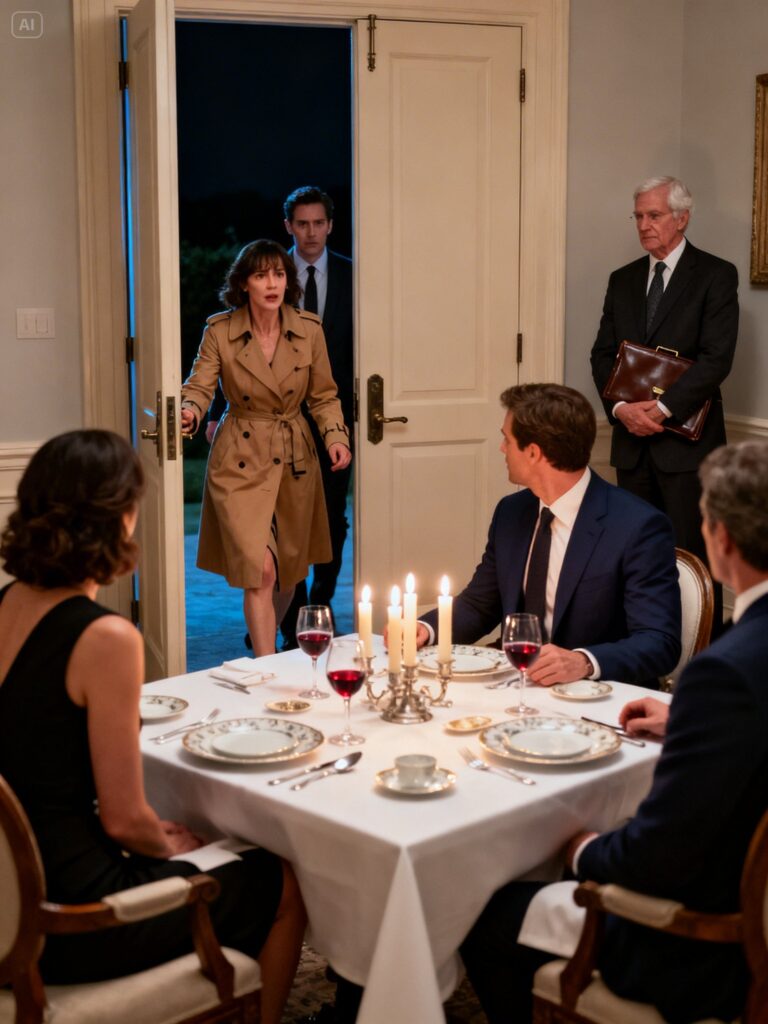
Richard Boon shifted slightly, adjusting the leather folder in his lap. His eyes avoided mine completely.
Then I looked back at the contract.
I held on to it. I didn’t react. Not yet.
“Victor’s family has been very patient,” my mother added, her hand brushing lightly against my arm. “Very generous.”
Victor glanced down at his watch.
And in that moment, something settled into place. He wasn’t here because he wanted a partner. He was here to settle a debt.
And I was the payment.
I looked at the pen resting beside my plate. Then at the signature line, my name already printed beneath it, waiting.
I didn’t reach for it.
Instead, I set the contract back down. Then I stood. The chair legs scraped sharply against the floor.
My mother’s expression didn’t shift.
“You haven’t finished reading it.”
“I don’t need to finish reading it. I don’t agree to it.”
I turned toward the front door.
One step. Two. Three.
My father was already there. Same stance as three years ago. Back against the door, arms folded, chin lowered. A wall built from silence and certainty.
I stopped just a couple of feet in front of him, close enough to catch the faint smell of motor oil that never quite leaves his hands.
Nothing.
“Dad, move.”
His eyes flicked briefly past me toward my mother, then returned. He didn’t unfold his arms, didn’t shift, didn’t speak. He just stood there, the same way he always had, blocking every doorway that mattered.
Behind me, my mother’s voice came, smooth and final.
“You’re not going anywhere tonight, Jessica.”
The air in the room tightened. I heard the officiant clear his throat softly. Victor returned to the couch, crossing one leg over the other, settling in like time wasn’t a factor for him.
Three years ago, this exact situation would have broken me. My father at the door, my mother narrating my failure, me trapped in the middle, overwhelmed, cornered, small. I had cried, I had pushed past him, and I had left.
I didn’t come back for eight months.
But tonight was not that night.
Tonight there was a contract on the table, an officiant waiting, a man who had driven forty minutes here expecting to marry someone he had never even spoken to.
Tonight was different.
I inhaled slowly, then turned around, walked back to the table, and sat down.
Not because I was giving in.
My mother’s eyes lit up the second I did. She thought she’d won.
She hadn’t.
She reached across the table and took my hands. I let her. It took more effort than I expected not to pull away.
“Jessica,” she said softly.
That voice. The one she used when I was twelve and didn’t make the volleyball team. The one she used when she told me my dog wasn’t coming home.
Gentle. Sympathetic. Weaponized.
“I carried you for nine months,” she continued. “I raised you. I sacrificed everything. My body, my career, my life. Twenty-seven years, Jessica, and all I’ve ever asked is this one thing, that you let me hold my head up in this town.”
A tear slipped down her cheek. Perfect timing.
I watched Richard shift again in his seat. He looked uncomfortable.
Good. He should be.
Victor didn’t even glance at her. He checked his watch again. The tears weren’t for him, and they weren’t really for me. They were for the man in the corner, to keep him seated, to keep this moving.
“Mom,” I said quietly.
“Don’t mom me,” she snapped, the softness vanishing in an instant. “Not tonight. Tonight, you’re going to do the right thing for once.”
I looked down at the contract, at the pen, at the candlelight flickering across the mantel. Then I looked at her, really looked, and I saw it clearly.
The pattern. Tears, then guilt, then control. The same sequence over and over.
When I wanted to go out of state for college. When I tried to move out. When I stopped answering her calls every day.
Cry. Blame. Control.
Cry. Blame. Control.
Three years ago, this would have shattered me.
Tonight, it confirmed everything I had written down. Every entry. Every moment.
I picked up the contract again.
My mother stopped crying instantly, her eyes sharpened with anticipation, but I didn’t reach for the pen.
As I sat there holding those pages, one question kept circling in my mind.
Why did she think this would work?
Did she truly believe I would sign something like this just because she cried? Or did she know I wouldn’t and simply not care?
I still think about that sometimes. What makes a parent cross that line? From wanting the best for their child to believing they have the right to decide their life.
What do you think? Why do some parents go this far to control their own children? Tell me in the comments.
I held the contract in both hands, six pages. My entire life condensed into blue ink and empty signature lines.
Then I turned, not to my mother, not to Victor, but to the man in the corner.
“Excuse me,” I said. “May I ask you something?”
Richard Boon straightened in his chair.
“Of course.”
“When were you contacted about this ceremony, and by whom?”
He blinked, caught slightly off guard.
“Mrs. Archer reached out to me last week. She told me both parties had consented.”
A pause. His eyes shifted briefly toward my mother.
“That’s correct.”
I nodded once.
“This is the first time I’ve heard about this marriage,” I said evenly. “The first time I’ve met Mr. Hail, and the first time I’ve seen this contract.”
I lifted it slightly so he could see.
“My name was filled in without my knowledge.”
The room went still. Not quiet in a comfortable way. The kind of silence where everyone is recalculating, repositioning, deciding what comes next.
Richard’s expression changed. The polite smile faded. Something sharper took its place.
“Mrs. Archer, you told me both parties—”
“She’s nervous,” my mother cut in quickly. “Pre-wedding nerves. You know how young women are.”
“I’m not nervous,” I said. “I’m stating facts.”
Richard looked at the contract again, then at my father standing in the doorway, then back at me.
I leaned forward just slightly.
“Under Georgia law, a marriage ceremony conducted without the voluntary consent of both adult parties is void, and the officiant who proceeds anyway can face criminal liability.”
I watched the color drain from his face slowly, noticeably.
My mother let out a short laugh.
“Jessica, enough with the dramatics.”
But Richard wasn’t laughing. And he wasn’t comfortable anymore either.
Something in the room shifted, like a current reversing direction.
He began to stand.
My mother’s hand shot out toward him.
“Sit down.”
The sweetness in her voice dropped completely, like a mask hitting the floor.
She turned back to me, and for the first time that night I saw her clearly. Not the concerned mother. Not the gracious host.
The controller.
“Jessica Marie Archer,” she said, her voice low and sharp. “I am not asking for your opinion. I am telling you what is going to happen.”
From the doorway, my father spoke for the first time.
“Listen to your mother.”
My mother turned back to Richard.
“You do your job. I’ve already paid you.”
He froze halfway up, one hand gripping the armrest.
Victor shifted slightly on the couch. The calm, reasonable exterior slipped just enough to reveal the impatience underneath.
“I didn’t drive forty minutes for a discussion,” he said. “Are we doing this or not?”
I looked straight at him.
“Are you asking me or them?” I said. “Because from where I’m sitting, you’re negotiating with my parents, not with me.”
His mouth opened, then closed. His eyes flicked toward my father.
I felt my purse against my side. Inside it, folded neatly in an envelope, was something none of them knew about.
My hand brushed the strap for a moment, then I let it fall.
Not yet.
I glanced toward the kitchen clock. 7:32 p.m.
My mother stepped closer, lowering her voice like she was sharing something intimate, but her eyes were hard.
“Three years on your own,” she said. “And what do you have? A cheap apartment and a job taking care of other people’s animals.”
She said it like a final judgment, like she had measured my life and found it lacking.
I held her gaze, and behind that gaze, behind everything, I started counting.
My phone buzzed once inside my purse. Then again.
I didn’t look. I didn’t need to.
Alyssa had said she would text when dispatch confirmed.
My mother kept talking. Something about Victor’s family, their land, their status. I caught pieces of it. The rest faded into noise.
“And his mother, God rest her, would have loved you.”
“Jessica.” Her voice sharpened. “Are you listening?”
“Every word.”
She leaned across the table. The scent of her perfume, heavy vanilla, the same one she’s worn my entire life, filled the space between us.
“You have two choices,” she said. “You sign this contract or you never call me Mom again.”
I heard it, not just the words, but what they meant.
And something inside me shifted.
I felt lighter, like she had just opened a door she meant to lock.
She thought it was a threat.
It wasn’t.
It was permission.
I looked around the room one last time. My father at the door, arms still crossed. My mother flushed, rigid. Victor on the couch, waiting with the patience of someone who believes the outcome is already decided. Richard in the corner looking like he wished he were anywhere else.
Then I slipped my phone out just enough to see the screen.
Alyssa’s message: Confirmed with dispatch. Send the word anytime.
I typed one word with my thumb. I didn’t look down. I didn’t need to. I had practiced it in the car.
Now I slid the phone back into my purse.
Then I looked up and I smiled. Not the small, careful smile I’d learned to give. Not the one that asks for approval.
A real one. Calm. Certain.
The kind of smile you only wear when you already know exactly what happens next.
My mother noticed it immediately. Her eyes narrowed.
“What’s so funny?”
“Nothing,” I said quietly. “Not a single thing.”
I picked up the contract again, slowly, deliberately, turning each page like I had all the time in the world.
“Since we’re all here,” I said, “let me walk you through what I found.”
My mother straightened slightly. I saw it in her face.
Relief.
She thought I was giving in.
I wasn’t.
I flipped to the second page.
“Section three. Assets of the bride.”
I ran my finger lightly across the line.
“My savings account balance is listed here. Nine thousand eight hundred sixty dollars.”
I looked up.
“I have never shared that number with anyone in this room.”
Silence. Thick. Heavy.
I turned another page.
“Page four, section seven. Marital residence.”
I read without rushing.
“The Hail property off U.S. Route 80. No alternatives listed. No provision for independent housing.”
Victor shifted slightly on the couch. His posture tightened.
I turned to the next page.
“Page five, section nine.”
This time I slowed down even more, letting every word land.
“The bride agrees to relinquish independent employment within sixty days of the marriage date.”
I lowered the paper.
“You want me to quit my job?”
My mother’s expression didn’t change.
“Victor’s family doesn’t need you working.”
“This isn’t about what his family needs,” I said. “This is about removing my income so I can’t leave.”
I glanced toward Richard. His folder was closed now, hands resting on top of it. He was watching me the way people watch something unfolding that they can’t stop.
I turned back to Victor.
“Did you write this? Or did my mother?”
His jaw tightened.
“The terms are standard.”
“Standard for what?”
No answer.
I shifted my gaze back to my mother.
“You listed my bank balance. You decided where I would live. And you added a clause that cuts off my ability to earn money. And you signed it before I even knew it existed.”
I placed the contract back on the table, centered, precise, like evidence.
“This isn’t a marriage, Mom,” I said. “This is a sale.”
The word landed and stayed there, sharp, unavoidable.
I turned my head toward my father. He hadn’t moved, not once. Still standing at the door like nothing in the room applied to him.
“Dad,” I said, “how much do you owe them?”
His chin lifted slightly.
“That’s none of your business.”
“It is,” I said, “because I’m what you’re offering to settle it.”
The room went still. Even the candle flame seemed to steady.
Victor looked at my father. My father looked at the floor.
My mother’s hand slammed down on the table.
“Don’t you dare accuse your father.”
“Seventy-five thousand dollars,” I said evenly.
Her face tightened.
“A land loan that went bad last spring. He’d already defaulted. There was nothing left to refinance. No extension left to negotiate. And instead of fixing it, selling something, working out a payment plan, you decided to sell me.”
My father’s arms dropped to his sides for the first time that night.
Victor stood up.
“I don’t think that’s an accurate way to—”
I didn’t let him finish.
Richard stood as well, gripping his folder.
“I think I need to reconsider my involvement here.”
“Sit down,” my mother snapped, her voice cracking sharp and loud. “I paid you. You’re going to—”
“Ma’am,” he said firmly, raising a hand, “if this is not a voluntary union, I cannot proceed. I will not proceed.”
He took a step toward the door, but my father was still there, not blocking it with intention anymore, just occupying it, out of habit, out of weight, out of a lifetime of never stepping aside.
“No one’s leaving yet,” my father said, not angry, just tired.
Richard stopped, looked at the door, looked at him, then at me, and I saw it register.
He was trapped too.
My mother hissed under her breath.
“I’ll deal with Clara later.”
Richard tried again.
“Mr. Archer, I need to leave. This is not happening. I’m not performing this ceremony.”
