And in a place like Savannah, once you’re labeled the villain, that label sticks. Small communities remember everything, but they don’t care much about context.
If I went and refused, my father would block the door. I knew that because he’d done it before.
“You walk out, don’t come back.”
I walked anyway, but that night there was no officiant waiting, no stranger in a suit, no contract with my name already printed on it.
If I went and said yes, I would lose everything. My apartment. My job. The three years I’d spent learning what silence feels like when it’s chosen, not forced.
I pulled into my parking spot and just sat there for a while, the car idling in the dark. The engine clicked as it cooled. Somewhere nearby, a television cast a soft blue glow through a neighbor’s window.
And then something surfaced.
The notebook.
Three years’ worth of entries, dates, times, exact words. Every call where my mother told me I was an embarrassment. Every text from my father that was nothing but a single period, his way of expressing disappointment without ever saying it out loud. Screenshots of voicemails I couldn’t unhear.
I hadn’t kept it for evidence. I’d kept it because I thought I was losing my mind. I needed proof that what I felt wasn’t imagined.
I pulled it out of my nightstand drawer. Navy blue cover, corners worn down from being handled too many times. Three years of my mother’s voice pressed into those pages like dried flowers.
Except there was nothing delicate about them. Nothing worth preserving.
I flipped through more than two hundred entries.
October 14, two years ago. Mom called at eleven p.m. and said if I didn’t come home for Christmas, she’d tell Grandma I was living with a man. I wasn’t.
March 3, last year. Dad texted, “Your mother cried all night.” No explanation. I called him back. He hung up ten seconds later.
July 19. Mom told Aunt Helen I’d been fired from the clinic. I hadn’t. She just didn’t think it counted as a real job.
Entry after entry after entry. Dates, quotes, screenshots taped in with clear tape, edges peeling.
That night around eleven, I called Alyssa Grant. We’d gone to high school together. She’s a paralegal now at the county attorney’s office. She picked up on the second ring, which tells you everything about who she is.
I told her everything. The call from Clara. The dinner. The contract. Victor Hail. The officiant.
She didn’t interrupt, not once.
When I finished, there was a long pause on the other end. Then she said something that shifted everything.
“Jessica, listen to me. This isn’t family drama. This is coercive control, and there are legal protections for this in Georgia.”
She added that she had already flagged it as an immediate-risk case the night before.
I didn’t sleep that night, not because I was afraid, but because for the first time in three years, I wasn’t just recording what was happening to me. I was deciding what to do about it.
Friday morning, I called Dr. Evelyn Carter and told her I needed to take a personal day. She didn’t ask questions. She never does. That’s one of the reasons I’ve stayed there as long as I have.
By 8:30, I was already driving.
Thirty minutes later, I pulled into the lot outside the Chatham County Courthouse. Alyssa was waiting for me in the lobby. She had a folder in her hands.
“I pulled everything together last night,” she said, handing me a clipboard. “Emergency protective order. You write the narrative. I’ll guide you through the rest.”
I sat at a cold metal table in the hallway and started writing. Not everything from the notebook, just the pattern. Three years of pressure, isolation, guilt, the time my father blocked the door, and what Clara had told me was planned for that night.
I attached photo copies. Forty-two pages. Fourteen screenshots.
By 10:15, a duty judge had reviewed it. By 11:00, it was signed.
I held the paper in my hands and read it twice. My name. Their names. Five hundred feet. Effective immediately.
Then Alyssa handed me another form.
“Adult Protective Services complaint. This documents the pattern of long-term coercive control and opens a formal investigation.”
I signed it.
She filed it electronically while I sat in my car staring at the dashboard. Then she made one more call.
Dispatch.
She gave them my parents’ address in the Ardsley Park residential area. Told them I’d be there that evening. That an active protective order was in place. That there was a possibility I’d need assistance.
At 6:45 that night, I pulled up to the curb outside their house.
The porch light was on. My mother’s car sat in the driveway. Behind it, a black truck I didn’t recognize.
I reached into my purse, turned on the voice recorder on my phone, and dropped it back inside.
Then I took a breath.
I wasn’t afraid. For the first time in my life, I wasn’t afraid at all.
The front door was unlocked. That alone should have told me something. My mother never leaves doors unlocked.
I stepped inside, and the living room stopped me cold.
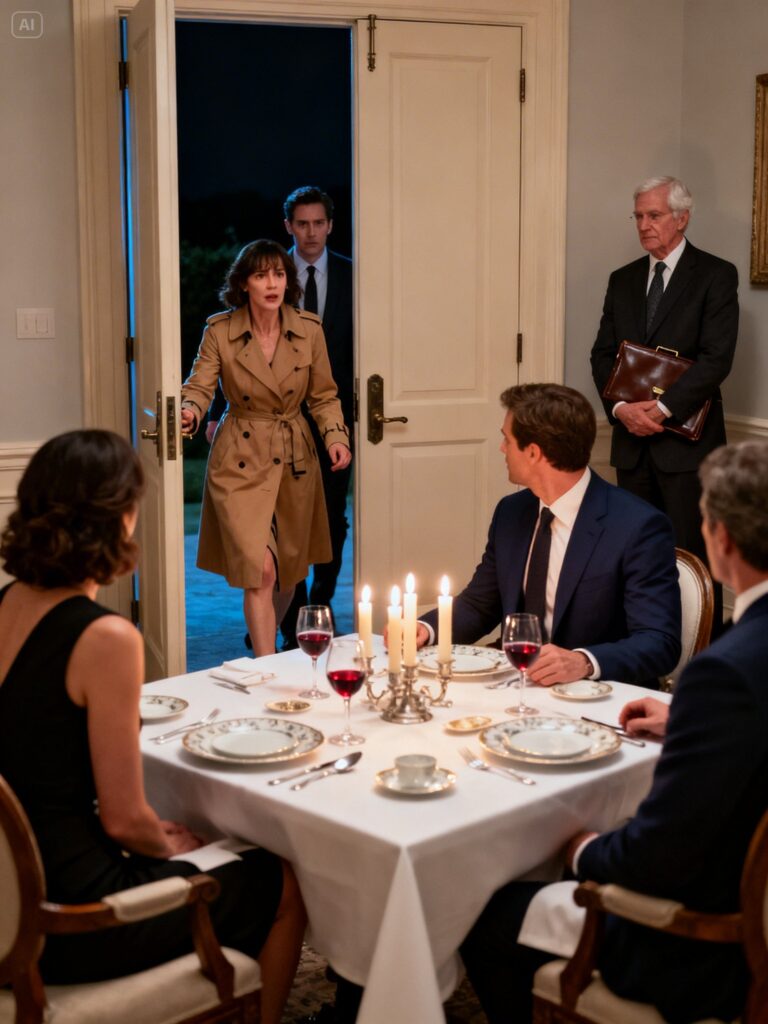
A white tablecloth stretched across the dining table. Fresh flowers arranged in a vase I’d never seen before. Candles lined the mantel, already lit. The air smelled like gardenias and polished wood, the scent she uses when she’s trying to impress someone.
This wasn’t dinner.
This was a performance.
A man stood up from the couch as I entered. Tall. Dark jacket. Crisp shirt. Clean-shaven. Early forties.
Victor Hail.
He gave me a small nod. Controlled. Measured. Like we were already in agreement.
I had never seen him before.
In the corner near the bookshelf, another man sat with a leather folder resting on his lap. Older, maybe in his sixties. Gray suit, slightly off in the shoulders. He smiled at me the way people smile at nervous brides.
Clara had described it perfectly. The man on the couch. The officiant in the corner. Even the positioning.
My mother appeared from the kitchen, drying her hands on a dish towel, her face bright with satisfaction.
“There she is,” she said warmly. “Come in, sweetheart. Everyone’s been waiting.”
She said it like this was a celebration. Like I was late. Like everyone had been patient.
I took in the room again. The table. The candles. The flowers.
Then I saw it. The chair set directly across from Victor, a pen placed neatly beside the plate. No food. No plates being served. Just staging.
And then I heard it.
The deadbolt clicking behind me.
I turned.
My father stood at the front door, arms crossed, back pressed against the frame. He didn’t speak. He didn’t need to.
Before I could even move toward the table, my mother slid a stack of papers across it.
Six pages stapled. Blue ink.
I looked down. The header read: Marital Asset Transfer Agreement.
Page three already carried two signatures at the bottom.
Mason Archer. Delilah Archer.
Beneath a line labeled parental consent and endorsement, my name was already typed into every blank.
Jessica Marie Archer.
Printed cleanly, perfectly aligned, like a form that had already been processed. Like I was something that had been approved without needing my input. A box someone had checked.
“What is this?”
My mother folded her hands neatly on the table, composed as ever.
“Your future.”
“Who signed this section?”
“Your father and I,” she said calmly. “Because you won’t do it yourself.”
“I’ve never even met him.”
“You are meeting him right now. Sit down.”
The man from the couch stepped forward. He extended his hand toward me. I didn’t take it.
“Victor Hail,” he said.
His voice was even. Flat. Not nervous, not warm, just efficient, like he was finalizing paperwork on a transaction that had already been negotiated.
“I believe you’ll find the terms very reasonable. Your mother assured me you’d be difficult, but cooperative.”
I glanced toward the officiant in the corner.
Continue reading…
